
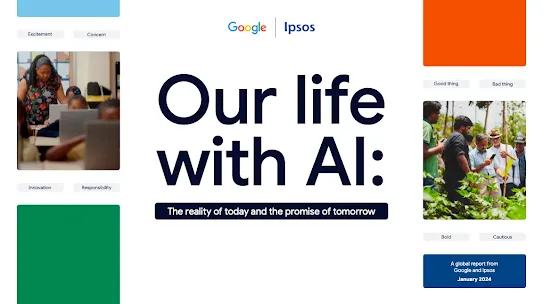
In the last few years, the conversation around AI has shifted as people have first-hand experiences with AI applications, hear about it in the news, and talk about AI’s future. To better understand global sentiment around AI, Google and Ipsos conducted one of the largest global AI surveys of over 17,000 participants across 17 countries resulting in a new report: “Our Life With AI.”
This survey is part of Google’s Digital Futures Project, an initiative that aims to bring together a range of voices to support researchers, organize convenings and foster debate on public policy solutions to encourage the responsible development of AI.
Key highlights:
Data presented represents an aggregate global percentage. The entire survey spans 17 countries globally. For more information on specific country and regional findings, see the full report.
Expectations About AI’s Impact
2023 was a big year for AI. It ushered in breakthroughs in generative AI, advancements in AI-powered personal assistants, and major leaps forward in healthcare, security, and manufacturing. Looking ahead, people see the potential of AI to help build a better world, positively impact society, and improve their daily lives.
Optimism about AI varies by country: it is highest in emerging countries. In Singapore and Brazil, for example, excitement outpaces concern (54% excited / 46% concerned in Singapore, 60% / 40% in Brazil). Overall, and in most countries, optimism is greater than overall concerns.
54%
globally believe AI will benefit people like them.
The global public see AI as a vehicle for a safer and more equitable world:
87%
globally view security -- detecting scams, security, risks, and other criminal activity and improving response to threats -- as a very or somewhat important application for AI.
Resoundingly, as people engage with AI through first-hand experiences or conversations, they feel more excited about its potential.
68%
of those who have used AI in the past year (globally) say they are excited about its possibilities.
A Changing Relationship With Work
One of the places where many expect to experience AI for the first time is through their day-to-day work:
As workers think about adapting to an economy with AI, education will be an important component: 44% of workers who feel their job will be impacted by AI anticipate needing to learn how to use AI, and 34% say they will need to reskill or take some type of coursework to adapt.
There is naturally some concern as workers think about adapting to an economy with AI. 1 in 5 (19%) workers who say their job will be impacted by AI believe they will need to find a new industry or role. This is slightly more pronounced among those without a college degree (21%) and those with lower incomes (22%).
Going beyond the workplace, people are optimistic that AI will help them improve their quality of life.
51%
of workers globally who believe their job or industry will be impacted by AI are already seeing improvements in speed or efficiency at work or expect to see them within 5 years.
The Desire for Innovation and the Need for Responsibility
As AI continues to develop and more people experience its benefits, they see the opportunities for innovation while wanting to ensure that innovation occurs within the right framework.
Continuing to innovate as AI develops is a clear priority. However, while innovation tops the list of desired AI approaches, innovation is followed by three words: “responsible,” “safe,” and “cautious.” Countries that are most likely to gravitate to an “innovative” approach include: Brazil (56%), Mexico (49%), the United Arab Emirates (48%), and Singapore (47%). Whereas Sweden (46%), Singapore (38%), Mexico (35%) and South Africa (35%) are among the countries most likely to emphasize “responsible” alongside “innovative.”
But the private sector alone is not enough. Public-private partnerships with academic institutions, international non-governmental organizations and governments will be critical to AI’s future.
With the foundation of Google’s bold and responsible approach and AI Opportunity Agenda, efforts such as the Digital Futures Project, where Google is providing $20 million in grants to think tanks and academic institutions around the world to bring voices together to better understand the opportunities and challenges of AI, are important steps in earning and maintaining this trust.
78%
globally agree that “government and technology companies should work together to oversee the development of AI.”
The survey shows that the potential and promise of AI is felt by people around the world. They see the opportunities to improve society, their work, and their personal lives. And when people get a chance to experience AI, they begin to be more excited about its full potential. As we continue to develop this technology, innovation must be tied to responsibility, reinforced through a network of partnerships that continue to build trust. It's incumbent on those, like Google, who are leading the development of this technology, to work with our partners to plainly explain its benefits and demonstrate the safeguards being built.
Want to learn more? Take a deeper dive into the full results – along with some important takeaways – in Ipsos and Google’s full report: “Our Life With AI.”